
Review · HANOI
Hanoi: Quintessence of Tonkin Show – A Cultural Spectacle
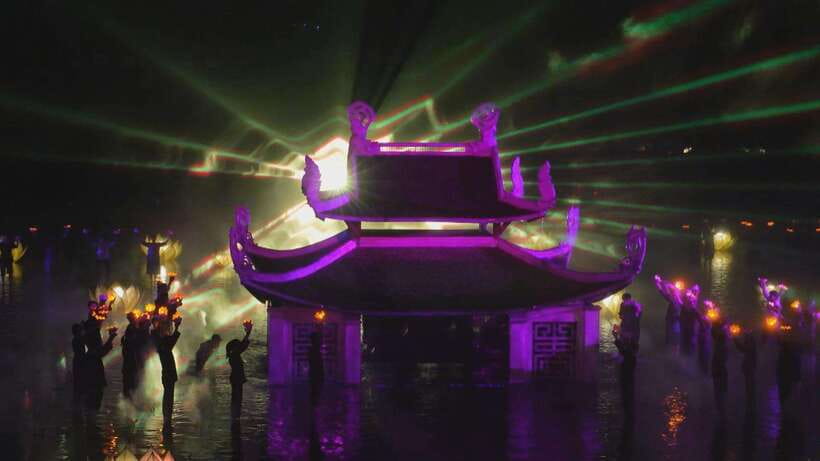
The most striking part of the Quintessence of Tonkin is its stage: a broad outdoor water setting near Thay Pagoda, where music, light, performers, and scenery work together to tell stories from northern Vietnam. Rather than sitting in a standard theater, you watch the action unfold across a lake-like space inspired by the Red River Delta.
I like the way the show connects water puppetry with the story of Tu Dao Hanh, the monk linked to Thay Pagoda and the creation of this old Vietnamese art. I also like the chance to arrive early, browse local snacks, and settle into the setting before the performance. The main drawback is that the story may be hard to follow if you do not understand Vietnamese, and the base price does not cover food or transportation.
Key points to know before you go
- Six acts cover rural life, religion, education, music, and village customs, giving you a broad look at northern Vietnamese culture in one evening.
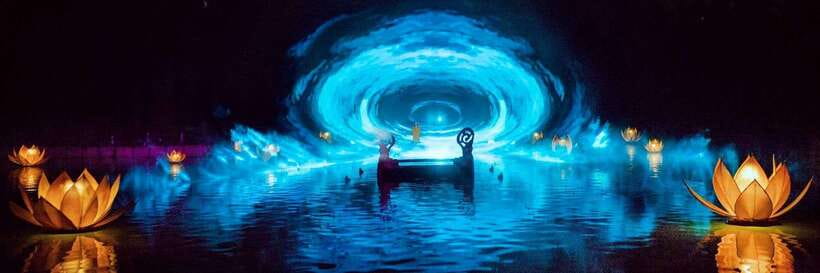
- The outdoor stage is part of the show, with water, lights, music, and the natural surroundings near Thay Pagoda shaping the performance.
- Arrive at least 60 minutes early, since the show begins at 7:30 PM and food vendors operate before the performance.
- The story centers on Tu Dao Hanh, a monk remembered as a healer, teacher, and early figure in Vietnamese water puppetry.
- The $42 price covers the performance ticket, but local food, drinks, souvenirs, and base transportation cost extra.
- Expect a visual experience more than an English-language explanation, since the cultural story is presented through songs, movement, and scenes.
Why this show belongs on a Hanoi evening plan
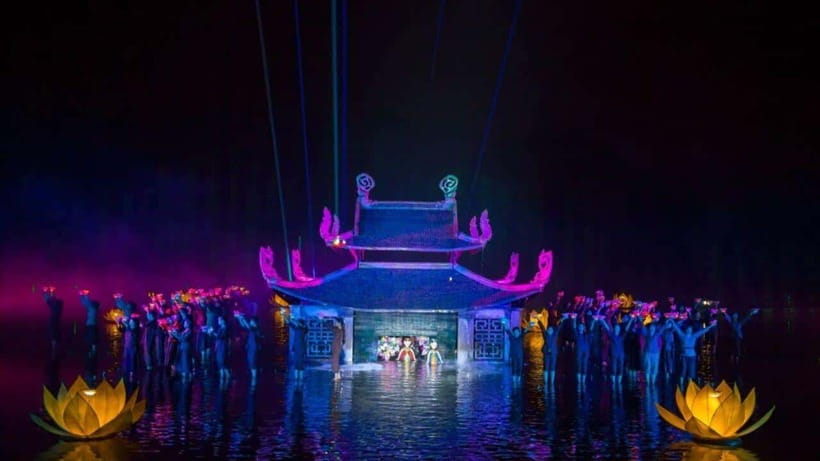
Hanoi has plenty of museums, temples, and food tours. The Quintessence of Tonkin gives you something different: a large-scale outdoor performance that gathers many parts of northern Vietnamese culture into a single evening.
The production takes place at the Baara Land cultural and recreation area in Sai Son, Quoc Oai, west of central Hanoi. The venue is associated with the Thay Pagoda area, a place connected with the monk Tu Dao Hanh. The show uses this setting as more than a backdrop. Its water, pagoda-inspired atmosphere, and open-air stage help create a sense of rural northern Vietnam.
I would think of this as a cultural performance with a strong visual element, not a traditional theater play with long spoken scenes. The story is carried by dance, music, folk singing, water puppetry, processions, and carefully arranged lighting. If you want every line explained in English, this may feel elusive. If you are happy to watch, listen, and pick up meaning from the action, the evening works better.
The production lasts about two hours, while the full activity takes around four hours. The extra time allows for arrival, food stalls, the performance, and time after the finale to enjoy the surroundings before leaving.
More Traditional and Cultural Shows in Hanoi:
- Xcaret Park Entry Tickets with Cultural Night Show Included
★ 4.5 · 2,382 reviews - Xcaret Park Day Trip, transportation and Cultural Night Show
★ 4.5 · 1,899 reviews - Dubai: Tour with BBQ Dinner, Camel Ride, & Traditional Show
★ 4.8 · 1,687 reviews
Arriving near Thay Pagoda
The stated meeting point is Tinh Hoa Bắc Bộ at Khu vui chơi và văn hoá Baara Land, Thôn Đa Phúc, Xã Sài Sơn, Quốc Oai, Thành phố Hà Nội. You can arrive at the venue yourself, and the activity ends at the same meeting point.
The timing matters. The show begins at 7:30 PM, and you are advised to arrive at least an hour before it starts. That means reaching the site around 6:30 PM. This is not wasted time. The pre-show period gives you a chance to see the open-air setting in daylight, find your place, and sample food from vendors before the performance.
Local snacks and refreshments are available at your own expense. The food is not included in the ticket, so bring enough Vietnamese dong or confirm accepted payment methods before you go. The food stalls are part of the evening atmosphere, but they should not be confused with a meal included in the $42 price.
There is an important transportation detail to check when booking. Some descriptions refer to inclusive round-trip transfer services, while the stated inclusions say transportation is not part of the base ticket and must be arranged separately. The meeting point is clear, but you should confirm whether your selected option includes shared or private transfers. Do not assume transport is covered simply because it may appear in a package description.
The first act brings rural Tonkin to the stage
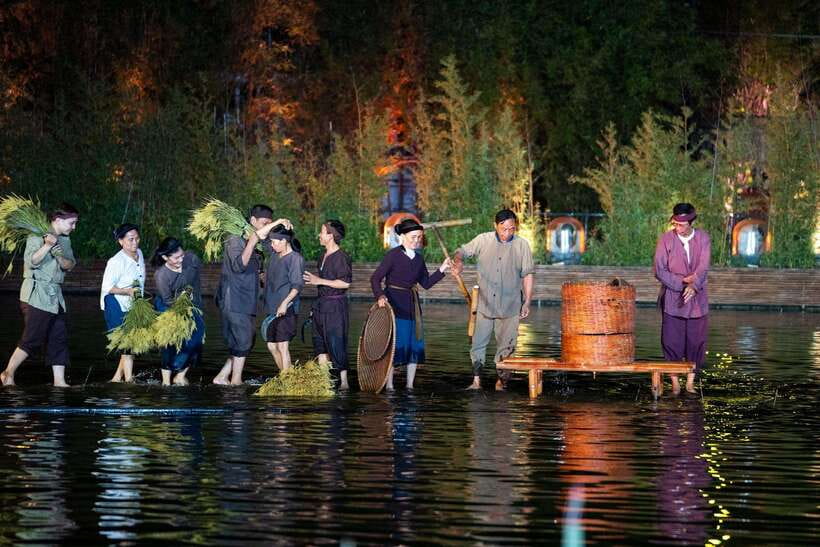
The opening act draws on the poetry of Nguyen Khuyen and presents traditional rural life. The songs named for this section include Tat Nuoc Dau Dinh and a Tonkin lullaby.
This opening is important because it sets the cultural language for the rest of the show. You are not being handed a fast collection of unrelated dances. The production begins with village life, farming, folk melodies, and the rhythms of ordinary people.
The stage design helps here. Water and open space recall the low-lying countryside of the Red River Delta, where waterways shaped transport, farming, work, and community life. The scene is likely to make more sense as a mood than as a plot. Look for the way the performers use the space, the music, and the water to suggest rural life.
You may not understand every lyric, but you can still follow the broad idea. This is an important point for English-speaking visitors. The show is made for a Vietnamese cultural audience first, so its emotional force comes from familiar songs and traditions rather than constant explanation.
Tu Dao Hanh and the beginnings of water puppetry
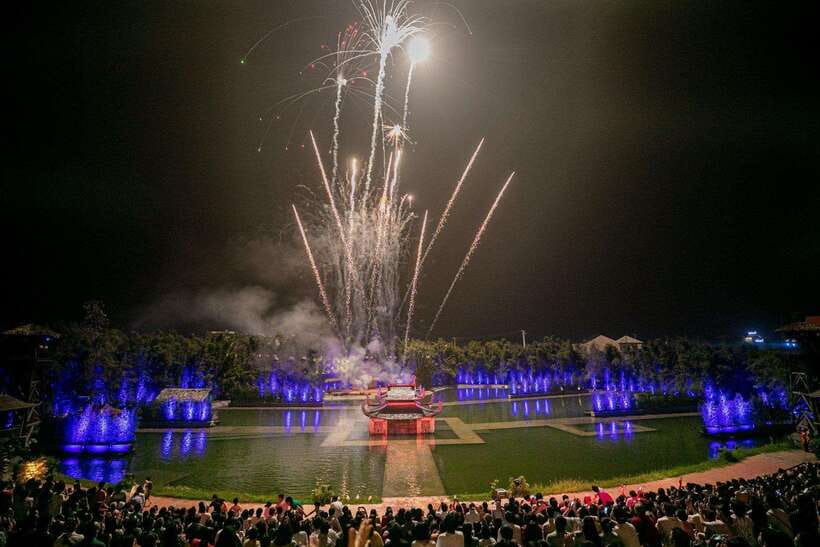
The second act tells the story of Tu Dao Hanh, the monk associated with the founding of Thay Pagoda. He is presented as a healer and teacher, as well as a figure connected with the development of water puppetry.
This part gives the performance its central thread. Thay Pagoda is not simply a scenic name attached to the show. The pagoda’s spiritual importance shapes the story, and Tu Dao Hanh links religious life, learning, healing, and performance.
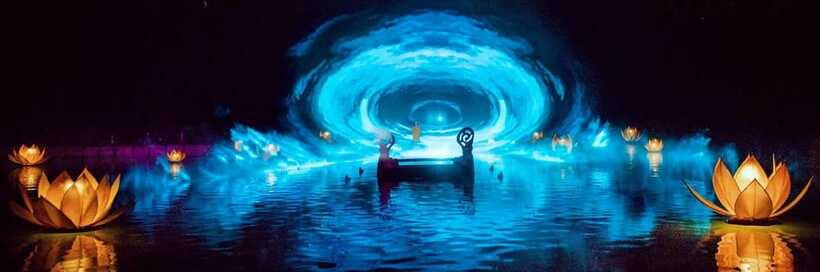
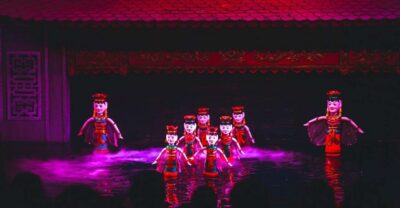
The water puppetry is one of the evening’s key draws. Vietnamese water puppets traditionally perform on a water surface, with the puppeteers hidden from view. Here, the technique becomes part of a much larger stage production, supported by light effects, music, and a large cast.
I like this act because it explains why water puppetry belongs in a show about northern Vietnam. It is not inserted as a random tourist feature. Instead, it is tied to the local setting and to the story of a figure associated with Thay Pagoda.
A few more shows around Hanoi worth a look
- Hanoi: Water Puppet Show Tickets
★ 4.6 · 7,029 reviews - Hanoi: Water Puppet Show Ticket with Hotel Delivery Add-On
★ 4.5 · 1,554 reviews - Hanoi: Thang Long Water Puppet Show Ticket – Skip The Line
★ 4.6 · 836 reviews - Thang Long Water Puppet Show Entry Ticket
★ 4.4 · 329 reviews
The mandarin examination and Vietnam’s academic past
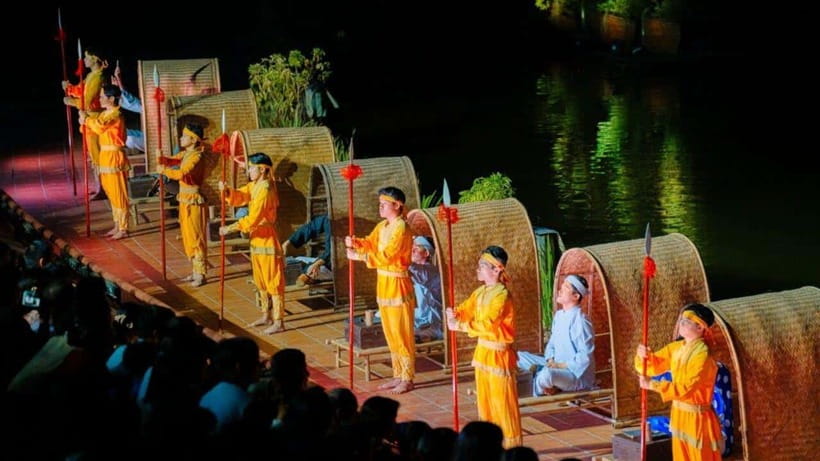
The next scene follows candidates traveling toward the Thang Long Citadel for the mandarin examination. They carry cloth bags and bamboo tents, details that give the scene a strong sense of period and place.
This act presents education as a public journey. The candidates are not shown in an abstract classroom. They travel, camp, and prepare for an examination that could shape their future. That gives you a glimpse of how learning, government service, and social standing were once connected.
The scene also adds a change of pace after the religious story. Expect movement across the stage, group action, and a sense of anticipation. The bamboo tents and cloth bags help turn the performance into a visual story, even when the spoken or sung words are difficult to understand.
For visitors with an interest in Vietnamese history, this is one of the most useful sections. It shows that the performance is not only about village entertainment. It also touches on the old relationship between scholarship, the royal court, and public life.
Fairies, instruments, and poetry beside the lake
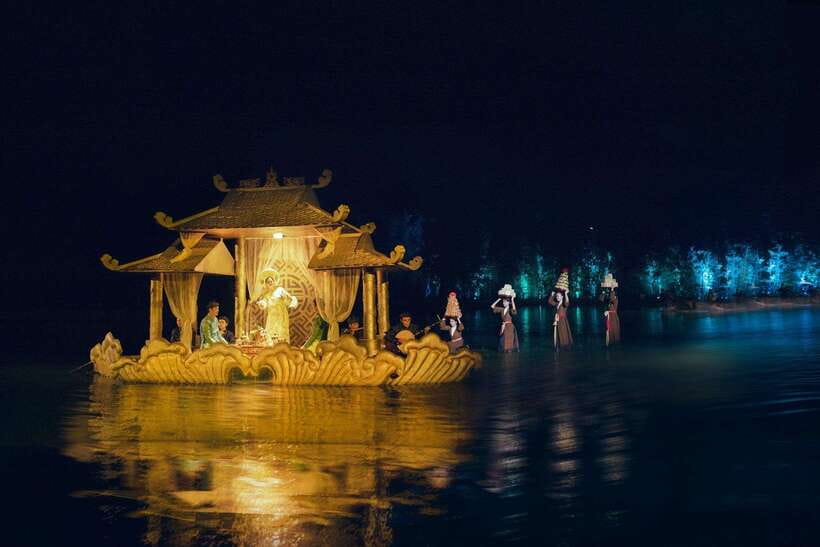
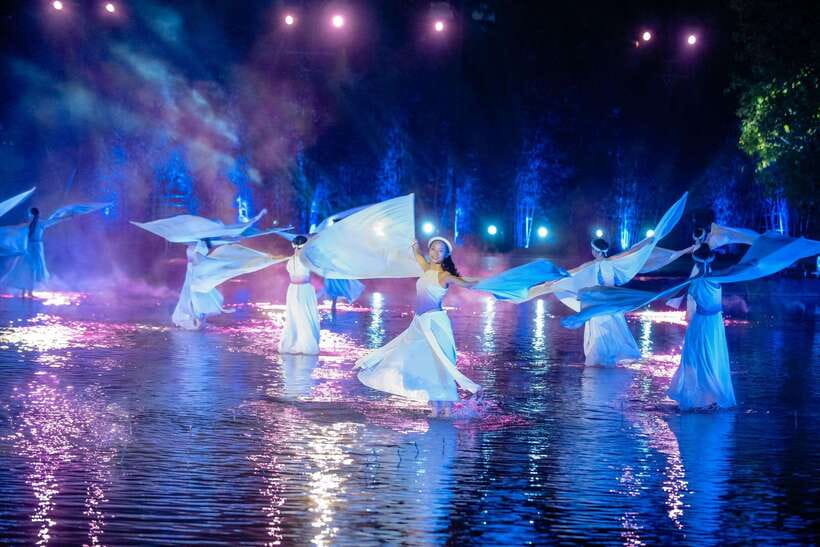
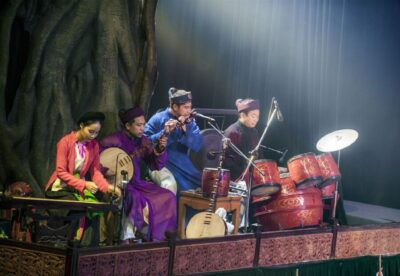
The stage then becomes a calm lakeside scene. Young women play traditional Vietnamese instruments, while fairies dance across the water. This section draws inspiration from the poetry of Ho Xuan Huong.
Expect this to be one of the more graceful and dreamlike acts. The production shifts away from examinations and public traditions and focuses on music, movement, poetry, and nature.
The water is especially important here. In a regular theater, a painted backdrop might suggest a lake. At this venue, the water is part of the stage itself. Reflections, lighting, and the movement of performers help create the scene.
The sequence may not offer a clear story in the usual sense. Instead, it creates an atmosphere tied to Vietnamese poetry and traditional performance. You will get more from it if you pay attention to the instruments, costumes, lighting, and group movement rather than waiting for a spoken explanation.
Mother Goddess worship and village spiritual life
Another act turns to the spiritual world of Vietnamese villagers. It focuses on worship connected with the Third Holy Mother and the Mother Goddess.
These beliefs are linked to farming, good fortune, and the hope for a successful life. The Mother Goddess worship tradition is recognized by UNESCO as Intangible Cultural Heritage, so this section offers more than decorative ritual. It presents a living part of Vietnam’s cultural and religious identity.
The production shows how spiritual practice can be woven into everyday concerns. A good harvest, health, family well-being, and prosperity are not treated as separate subjects. They belong to the same village world.
This may be one of the more difficult sections for an outsider to interpret without background. The movements, costumes, music, and ceremony carry meaning that may not be immediately clear. Still, the visual presentation gives you a starting point, and the program’s focus on religion helps place the scene in context.
Quan Ho songs bring the evening to a close
The final act ends with a challenge-and-response singing competition using Quan Ho folk songs. This form of singing is associated with northern Vietnam and often involves performers trading verses in a social exchange.
The finale also includes traditional games, customs, and the Song Loan and Song Dinh processions. The mood changes again, moving from spiritual ceremony to public celebration. The closing song, Nguoi Oi Nguoi O Dung Ve, marks the farewell.
This is a fitting ending because it gathers the evening’s main ideas: music, community, custom, movement, and the pleasure of taking part in shared traditions. It is less about a single hero winning a final battle and more about bringing village life together for a communal finish.
Stay through the end. The farewell song and processions are part of the planned experience, not an optional extra after the main act. Afterward, you can take photographs, enjoy the quiet setting, and gather your things before returning to the meeting point.
What the $42 ticket is really worth
At $42 per person, this is not the cheapest cultural activity in Hanoi. The value depends on what you want from the evening.
You are paying for access to a large production with six acts, a two-hour performance, water puppetry, traditional music, lights, dance, and a purpose-built outdoor stage. The setting near Thay Pagoda adds a cultural connection that a standard indoor show would not have.
The ticket does not include local snacks, drinks, souvenirs, or transportation in the base price. That can push up the total cost, especially if you also need a private ride to and from the venue. On the other hand, the length and scale of the production make the ticket more substantial than a short stage performance.
I see the best value for someone who wants a broad introduction to northern Vietnamese traditions in one organized evening. You see rural life, religious practice, historical education, poetry, music, water puppetry, and folk singing without arranging several separate visits.
The weaker value is for someone who mainly wants a short, easily explained performance in central Hanoi. The venue is outside the city center, and the story may not be fully clear without Vietnamese language skills or prior context.
Practical comfort and access
The activity is listed as wheelchair accessible. Since the performance is outdoors, check the exact transfer and seating arrangements when booking if you require particular access support.
Plan for the 7:30 PM start and arrive around 6:30 PM. The show takes place in an open-air setting, so practical comfort may depend on the evening conditions. The provided information does not specify seating style, weather arrangements, or whether umbrellas are supplied, so you should confirm those points if they matter to you.
The venue itself is designed to offer a peaceful atmosphere inspired by Thay Pagoda. That makes early arrival worthwhile. You can see the surroundings before it becomes dark and enjoy the pre-show food stalls without rushing to your seat.
The activity allows cancellation up to 24 hours before the scheduled time for a full refund, and a reserve-now, pay-later option is available. The information also says all sales are final and tickets are non-refundable, so check the exact booking conditions attached to your chosen option before paying.
Who will enjoy this cultural show most
I would recommend the Quintessence of Tonkin to you if you like performances that rely on music, images, costumes, and atmosphere. It suits anyone who wants more than a standard water puppet theater in a small indoor venue.
It is also a good fit for families and mixed-interest groups. One person can focus on the historical story, another on the music and dance, and someone else on the water effects and lighting. The food stalls give the evening an informal beginning.
You should think twice if you need a fully translated narrative. The performance is built around Vietnamese songs, cultural references, and visual scenes. One attendee described enjoying the show despite not understanding it, which captures the tradeoff well: the production can communicate through sight and sound, but not every detail will be obvious.
The show also works best if you are willing to spend most of an evening on it. With early arrival, a two-hour performance, and time afterward, this is not a quick stop between dinner and another attraction.
Should you book the Quintessence of Tonkin?
Book it if you want a large, atmospheric presentation of northern Vietnamese culture and you like the idea of watching water puppetry on an outdoor stage connected with Thay Pagoda. The six-part structure gives you a wide range of subjects, from rural songs and mandarin examinations to Mother Goddess worship and Quan Ho singing.
Skip it if you prefer compact shows, clear English narration, or a venue close to central Hanoi. Also confirm transportation before booking, since the base ticket does not clearly include shared or private transfers in all descriptions.
For the right audience, $42 is fair for a two-hour production with a specially built water stage and a broad cultural program. Arrive early, budget separately for food and transport, and treat the evening as a visual introduction to northern Vietnam rather than a literal play with every plot point explained.
FAQ
Where does the Quintessence of Tonkin show take place?
The meeting point is Tinh Hoa Bắc Bộ at Khu vui chơi và văn hoá Baara Land, Thôn Đa Phúc, Xã Sài Sơn, Quốc Oai, Thành phố Hà Nội. The activity ends back at the meeting point.
What time does the show start?
The show starts at 7:30 PM. You are advised to arrive at least 60 minutes early for the fuller experience.
How long does the activity last?
The total activity duration is about four hours. The traditional dance and cultural performance itself lasts around two hours.
Is food included in the ticket?
No. Outdoor food vendors offer local snacks and refreshments before the show, but these purchases are at your own expense.
Is transportation included?
Transportation is not included in the base ticket price and must be arranged separately. Some package descriptions may refer to transfer services, so confirm the details of your selected option before booking.
Is the venue wheelchair accessible?
Yes, the activity is listed as wheelchair accessible.
Can I cancel the booking?
Cancellation up to 24 hours in advance is listed as eligible for a full refund. The information also says that all sales are final and tickets are non-refundable, so check the conditions for your specific booking option.
Just added around Hanoi
- Hanoi city tour with water puppet show- small group tour★ 5.0 · 10 reviews
- Hanoi Street Food Walking Tour and Water Puppet Show★ 4.0 · 5 reviews
- Hanoi Cyclo Ride and Water Puppet Show★ 3.5 · 3 reviews
- Private: Hanoi Street Food tour with Water Puppet Show and Cyclo★ 5.0 · 8 reviews
- Thang Long Water Puppet Theater Entrance Tickets★ 4.0 · 15 reviews
- Skip the line: Thang Long Water Puppet Theater Entrance Tickets★ 4.5 · 5 reviews
- Deluxe Group Hanoi Sightseeing Including Puppet Show★ 4.5 · 2 reviews
- Thang Long Water Puppet Show Tickets★ 4.5 · 7 reviews
Hanoi Shows, compared.
Water Puppet Show Ticket with Hotel Delivery Add-On
Read our review →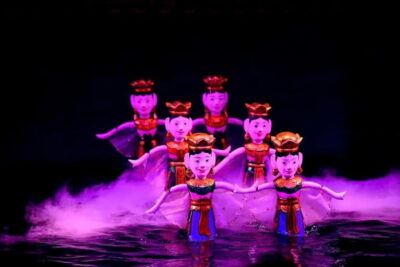
Thang Long Water Puppet Show Ticket – Skip The Line
Read our review →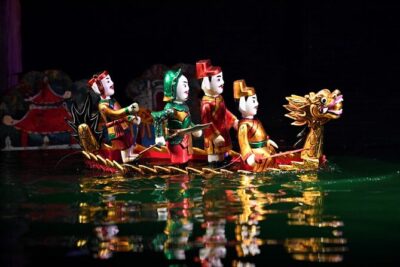
Skip the Line: Thang Long Water Puppet Theater Entrance Tickets
Read our review →Skip the Line: Thang Long Water Puppet Theater Entrance Tickets
Read our review →
Skip the Line: Thang Long Water Puppet Theater Entrance Tickets
Read our review →Browse the lists this show appears in