
Review · SPAIN
Andalusian Horses Dance Show
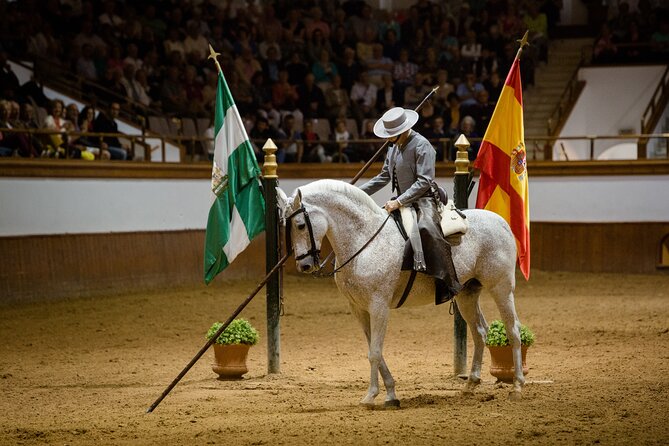
The most striking part of this Andalusian horse show is the control. Horses move through classical dressage exercises, Spanish riding traditions, carriage work, and acrobatic maneuvers with music guiding the performance. The setting is Jerez, the heartland of Andalusian horsemanship, not Cádiz proper, so you’ll need to plan the ride there carefully.
I like the broad range of riding on display, from one-handed cattle-herding techniques to the precision of piaffe and passage. I also like the family-friendly 90-minute length: long enough to feel substantial, short enough to hold a child’s attention. The main catch is seating. You buy a price category rather than a specific row, and a restricted view can take the shine off an otherwise excellent show.
Key things to know before you book
- Five riding traditions in one program: Expect some combination of doma vaquera, classical dressage, carriage driving, work in hand, and the final carrousel.
- The program changes by day: Each performance uses six to eight choreographies from the school’s repertoire, so no single list is guaranteed.
- Jerez is the actual destination: The Royal Andalusian School is at Avenida Duque de Abrantes, about 30 to 40 minutes by taxi from the Cádiz cruise port.
- Seats are assigned by category: You cannot choose a particular row or seat number when booking.
- Spanish narration may limit context: The riding is easy to appreciate visually, but explanations before each section are in Spanish.
- Bring a printed receipt: You must present it at the ticket office, and discounted tickets require proof of eligibility.
Why the Andalusian horse show is worth your time
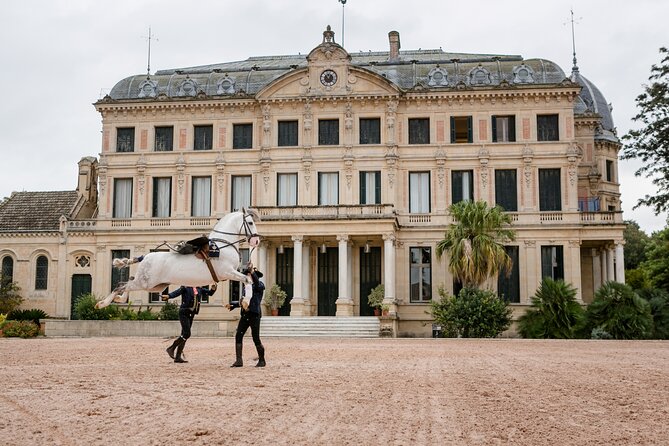
This is not simply a parade of handsome horses. The program presents several branches of Spanish riding, each with a different purpose and character. You may see the practical skills of a working horseman, the formal control of classical dressage, and the old carriage-driving tradition in the same arena.
The horses perform to classical music, which gives the show a ballet-like rhythm without turning it into a soft-focus pageant. The best moments come when the horse seems to respond to the smallest movement from the rider. That quiet communication is the real subject of the performance.
For me, the strongest reason to book is the variety. A standard dressage exhibition can feel technical if you do not already follow the sport. Here, carriage work, group riding, and the more theatrical exercises keep changing the pace.
The other strong point is the sense of place. Jerez is closely tied to Andalusian horse culture, and the Royal Andalusian School gives the performance a formal home. Afterward, you are near Jerez’s historic center, cafés, and other sights, so this can fit neatly into a day in town.
There is one important limitation. The show is designed for broad appeal, but the commentary does not appear to be offered in English. You can still understand the action, especially the dramatic jumps and synchronized riding, but you will miss some of the explanation about what each movement means.
More Dance Shows in Spain:
- Seville: Live Flamenco Dancing Show Ticket at the Theater
★ 4.7 · 16,396 reviews - Bali: Uluwatu Kecak and Fire Dance Show Entry Ticket
★ 4.2 · 5,189 reviews - Bali: Ubud Palace Legong Dance Show Ticket
★ 4.4 · 3,979 reviews
Arriving at the Royal Andalusian School
The ticket redemption point is the Royal Andalusian School of Equestrian Art at Avenida Duque de Abrantes, s/n, 11407 Jerez de la Frontera. The advertised start time is noon. You present your printed receipt at the ticket office and collect admission there.
Do not treat Cádiz and Jerez as interchangeable place names when planning transport. The show is in Jerez de la Frontera. One booking problem came from taking the wrong train stop because two nearby town names caused confusion, followed by an expensive taxi ride. Check your route before leaving, particularly if you are traveling independently from Seville or Cádiz.
From the Cádiz cruise port, the journey can take roughly 30 to 40 minutes by taxi. The fare may become costly if a driver waits for you during the performance, so agree clearly on the arrangement before setting off. If you are driving, nearby parking is possible, but advice about where to park may come from informal attendants. Confirm the cost yourself, and do not assume someone pointing toward a space is an official parking employee.
The school is near public transportation, but the supplied details do not promise a hotel pickup or a guided transfer. This is an admission ticket, not a full-day escorted tour. You handle your own transport to and from Jerez.
What happens inside the 90-minute performance
Each show contains six to eight choreographies selected from the school’s repertoire. The exact combination can change, but the performances are intended to have a similar level of difficulty and entertainment value.
That changing program is useful if you are deciding between dates. It also means you should not book with the expectation of seeing every named exercise. The program may include several of the following sections.
Doma vaquera and the working horse
Doma vaquera comes from the riding methods used by Spanish cattle herders. The horseman works with one hand, changing speed from a trot to a gallop and then adding tight turns, pirouettes, and sudden bursts forward known as arreones.
This section gives the show practical muscle. It is less about polished symmetry and more about the rider controlling a horse in the quick, forceful style needed for cattle work. If you are new to equestrian performance, this is a helpful contrast to the slower elegance of classical dressage.
A few more shows around Spain worth a look
- Cadiz: Andalusian Horses and Bulls Country Show
★ 4.6 · 189 reviews - Torremolinos: Spanish horse and flamenco show
★ 4.5 · 162 reviews - Seville: Horse’s Show Entry Ticket. Optional Stud Farm Visit
★ 4.3 · 10 reviews - Paris: Crazy Horse Cabaret Show
★ 4.7 · 2,726 reviews
Classical dressage and precise movement
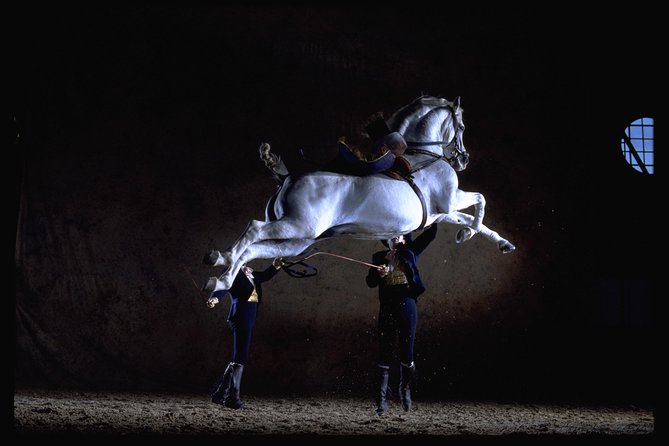
Classical dressage supplies the most recognizable horse dancing moments. The repertoire can include The Colts, Airs on Horseback, Pas de Deux, Passage and Piaffer, Domino on Horseback, Airs Above the Ground, and Fantasy.
You will see horses perform highly controlled movements to classical music. Piaffe is a collected movement in place, while passage is a measured, elevated trot. Other exercises may involve raised forelegs, coordinated pairs, or more theatrical aerial work.
The appeal is not speed. Watch the rider’s posture and the horse’s rhythm. The most impressive work can look almost effortless, which is precisely why it is easy to underestimate. Small errors would be obvious to a trained eye, but the polished presentation keeps the focus on grace rather than strain.
Carriage driving and traditional harness
In the carriage-driving section, horses pull traditional carriages while coachmen guide them through the arena. The animals wear classical harness, and the drivers demonstrate control over both the horses and the vehicles.
This adds a historical feel without requiring you to know the technical details of carriage sport. The scale changes, too. Instead of watching one horse and rider work in close partnership, you see a larger moving unit that must turn and stop with care.
The carriages were once used for transportation and are now used for sport and exhibition. That practical origin helps explain why this section belongs in a school dedicated to the traditions of Andalusian riding.
Work in hand and Haute École exercises
Work in hand shows the horse responding even when the rider is not seated in the saddle. The handler gives commands from the ground while the horse performs advanced Haute École exercises.
The named movements include levades, caprioles, courbettes, piaffe between pillars, the Spanish walk, and long-rein work. Some of these are difficult to identify from a distance, so the quality of the training may be clearer than the exact name of each exercise.
This is one of the sections where an English explanation would help. If you already know dressage, you will have more to identify. If not, watch the horse’s posture, balance, and response to the handler’s small cues.
The carrousel finale
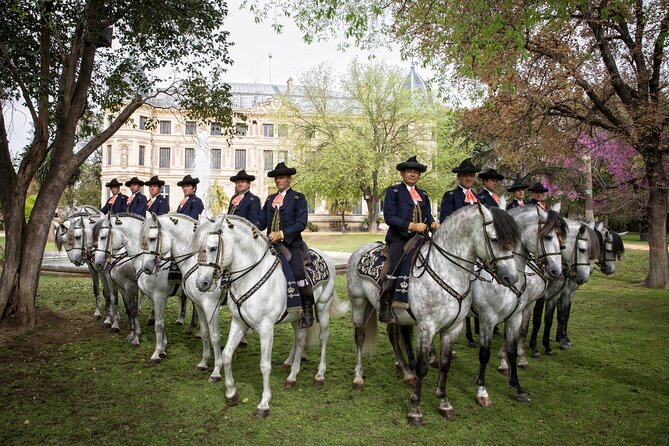
The carrousel brings several horses and riders into the arena together. They perform in unison, completing a coordinated finale in the center of the ring.
Group riding is a fitting ending because it gathers the show’s central ideas: control, rhythm, trust, and precision. A single horse can impress you with a difficult maneuver. A group moving together makes you appreciate the planning behind every turn and change of pace.
Seating can shape the whole experience
The ticket system sells seats by price category, not by selected row or seat number. The school allocates seats according to the order of purchase or booking, so you cannot simply choose your preferred spot at checkout.
This matters more than it might at a small theater. The arena is large, and one section of the performance can disappear if a pillar, wall, or angle blocks your view. One poor experience came from a restricted view that hid about a quarter of the arena.
The advice is not simply to pay for the most expensive ticket without thinking. First, understand that the category does not guarantee a particular seat. If seeing every corner of the arena is important to you, ask at the ticket office whether any view restrictions apply to your assigned place.
Another point is height. A seat farther back or higher up can sometimes give you a better view of the full formation, especially during the carrousel. Front-row seats put you close to the horses and riders, but they may not provide the widest view of group choreography. Several strong experiences came from the front row, while another recommendation favored sitting higher. The best position depends on whether you prefer closeness or a complete view of the arena.
Heat, language, and rules to keep in mind
The arena can become warm in summer. Bring a fan and dress for the season, since the show lasts about an hour and a half. This is a small practical detail, but it can make a large difference when you are sitting still in the midday heat.
The spoken explanations before each segment are in Spanish. Announcements may be made in several languages, but the riding commentary itself is not guaranteed to be translated. You can follow the major action without Spanish, yet a short printed guide or English explanation would make the technical sections easier to understand.
Photography, filming, and recording are not allowed unless you are an authorized professional. Bottles, cans, animals, and other objects that management considers unsuitable are also prohibited inside the grounds. Follow the rules rather than trying to capture a few clips. The show is carefully presented, and interruptions would spoil it for everyone.
The school has a café and shop, and the grounds are worth allowing extra time for if access is available before or after the performance. Arrive early enough to find the correct ticket window and get oriented. Signage can be unclear, and prepaid tickets may be handled at a different window from the one you first expect.
Is $33.43 a fair price?
At about $33.43 per person, the admission is not a bargain-basement attraction, but it offers a polished 90-minute production with trained horses, riders, music, carriages, and several styles of riding.
I consider it good value if you are already planning time in Jerez or have a strong interest in horses, dressage, or Spanish traditions. The price is harder to justify if you must add a costly taxi from Cádiz, especially if a driver waits during the performance.
The ticket includes entrance to How the Andalusian Horse Dance. It does not include admission to other facilities. Transport, food, and optional extras are also your responsibility, so calculate the full day cost rather than looking only at the ticket price.
Because the show averages booking about 31 days ahead, popular dates may fill early. Booking ahead also matters because seats are allocated by booking order within the price category. If your schedule is fixed, leaving this until the last minute may give you fewer choices.
Free cancellation is available if you cancel at least 24 hours before the local start time. Cancellations or changes made less than 24 hours ahead do not qualify for a refund.
Who will enjoy this most?
I would choose this for:
- Families looking for a manageable cultural activity
- Horse lovers and dressage fans
- Anyone interested in Andalusian customs beyond food and architecture
- Visitors spending a day in Jerez
- Cruise passengers willing to arrange transport carefully
- People who enjoy classical music, ballet-like movement, and traditional sport
You may want to skip it if you dislike animal performances, need extensive English commentary, or have little tolerance for uncertain seating. The performance is visual and polished, but it is not a guided history lesson.
Children can follow the obvious action, especially the galloping, carriage work, jumps, and final group display. Older children may also enjoy trying to spot the differences between a working riding style and classical dressage.
Should you book the Andalusian horse show?
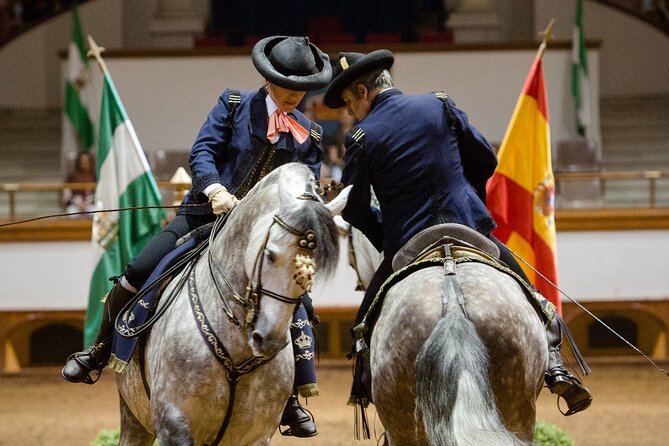
Yes, if you want a focused and distinctly Andalusian event rather than another standard city tour. The horses are the clear stars, but the show also gives you a useful look at Spanish riding traditions that are difficult to appreciate from a museum label.
I would book it as part of a Jerez day, with enough time for transport and a little wandering afterward. From Cádiz, compare the taxi cost with the value of the ticket before committing. When you book, remember that a ticket category is not a chosen seat, bring the printed receipt, prepare for Spanish-only performance explanations, and ask about your view on arrival.
For most people, the combination of skill, music, and variety earns the price. Just treat seating and transport as part of the decision, not as minor details.
FAQ
Where does the Andalusian horse show take place?
It takes place at the Royal Andalusian School of Equestrian Art, Avenida Duque de Abrantes, s/n, 11407 Jerez de la Frontera, Cádiz, Spain.
What time does the show start?
The listed start time is 12:00 pm. You should allow time to reach the ticket office and present your printed receipt before the performance.
How long does the performance last?
The show lasts approximately 1 hour and 30 minutes.
What riding styles are included?
The repertoire includes doma vaquera, classical dressage, carriage driving, work in hand, and a coordinated carrousel. Each performance uses six to eight choreographies, and the exact program can change by day.
Can I choose my seat?
No. Tickets are sold by price category, and the school assigns the row and seat number according to booking or purchase order. Restricted views are possible.
Can I cancel for a full refund?
Yes, if you cancel at least 24 hours before the experience start time. Cancellations and changes made less than 24 hours before the start are not accepted for a refund.
Just added around Spain
- Albaicín and Sacromonte Sunset tour + Flamenco show★ 5.0 · 11 reviews
- Flamenco Show in the Caves of Sacromonte★ 4.5 · 26 reviews
- Granada Tapas Trail & Gypsy Flamenco Show★ 5.0 · 7 reviews
- Traditional Flamenco Show★ 4.5 · 138 reviews
- Flamenco Show Ticket at tablao Jardines de Zoraya Granada★ 4.5 · 162 reviews
- Flamenco show at Cueva Los Amayas, in Sacromonte★ 4.5 · 140 reviews
- Grenada: Flamenco Palace, the best show in the center★ 5.0 · 96 reviews
- Authentic Flamenco Show at the Teatro Flamenco Granada★ 5.0 · 83 reviews
Spain Shows, compared.
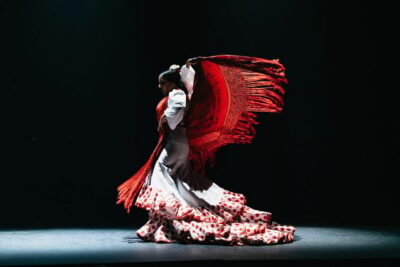
Live Flamenco Dancing Show Ticket at the Theater
Read our review →
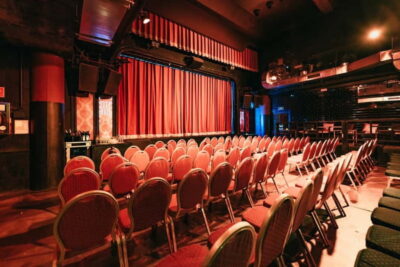
Live Flamenco Show with Food and Drinks Options
Read our review →
Puro Flamenco Show with Optional Museum Ticket
Read our review →
Browse the lists this show appears in