
Review · ITALY
Rome: Welcome To Rome Immersive Multimedia Show
Rome: Welcome To Rome Immersive Multimedia Show Review
Rome’s story is hard to grasp from street level. You see a temple wall beside a church, a Renaissance palace over an ancient road, and modern traffic flowing around it all. This 27-minute projection show gives you the missing timeline, showing how the city changed from its earliest days to the Rome you see today.
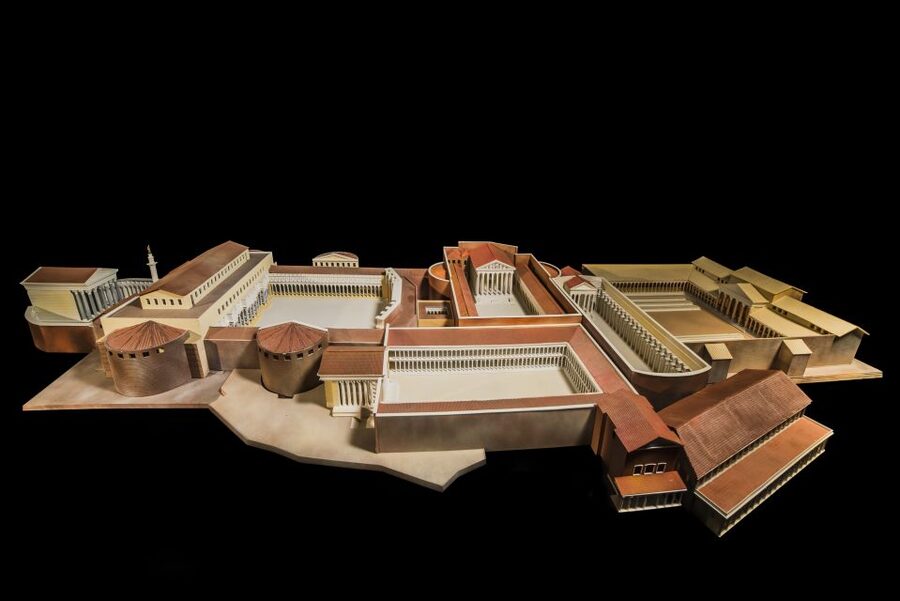
I like two things right away: the large city model makes Rome’s growth easy to picture, and the projections bring monuments to life without asking you to read long museum panels. The four interactive models of the Imperial Forum, Augustus Forum, Mausoleum of Hadrian, and St. Peter’s Basilica add useful detail.
The main consideration is price. At $21 per person, this is not a cheap filler activity, and the central show is short. It offers good value if you want historical context, but it should support your visits to Rome’s real monuments, not replace them.
Key points to know before you go
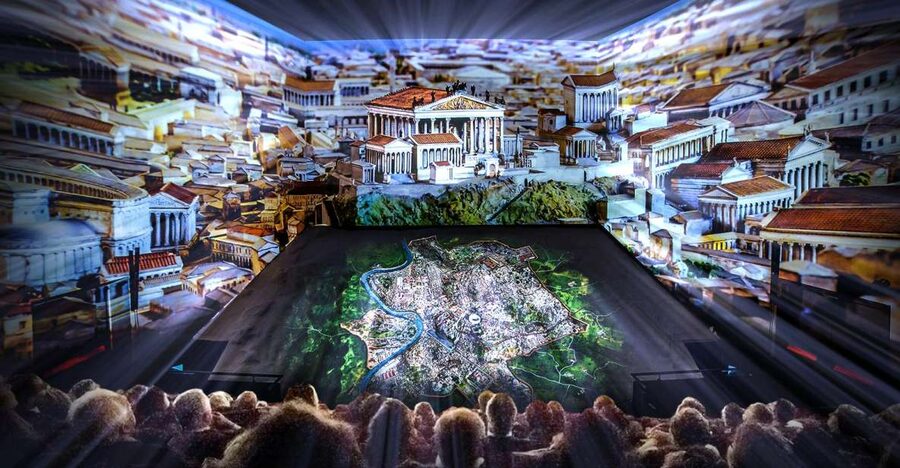
- A 27-minute journey through 2,700 years: Large projections show Rome’s changing streets, buildings, and monuments in chronological order.
- A useful first stop: Go early in your Rome visit so the Colosseum, forums, churches, and palaces make more sense afterward.
- Four hands-on models: Study the Imperial Forum, Augustus Forum, Mausoleum of Hadrian, and St. Peter’s Basilica at closer range.
- Flexible timing: The show runs continuously during opening hours, so you can begin when you arrive instead of waiting for a fixed departure.
- Nine audio guide languages: Choose Italian, English, Spanish, French, German, Russian, Chinese, Croatian, or Japanese.
- Easy central location: The entrance is at Corso Vittorio Emanuele II, 203, a few hundred meters from Piazza Navona.
Why Rome is difficult to understand on foot
Rome can feel like several cities piled into one. The ruins of imperial Rome sit beside medieval churches. Baroque fountains fill old public spaces. Roads, apartments, and shops follow routes that may be far older than they look.
That layering is part of Rome’s appeal, but it can also leave you asking basic questions. Where did the ancient city end? How did the forums fit together? Why are some structures standing while others survive only as fragments? What did the buildings look like before centuries of damage and rebuilding?
Welcome To Rome tackles those questions with pictures and scale. Instead of asking you to imagine the ancient city from a few scattered columns, it shows the city changing over time. You see Rome expand, monuments rise, older buildings disappear, and later neighborhoods form around the remains.
That makes the show especially helpful before a first visit to the Colosseum, Roman Forum, Palatine Hill, Pantheon, or major churches. I would not treat it as a substitute for those places. I would use it as a visual map that helps you know what you are looking at.
A few more shows around Italy worth a look
- Glass Blowing Show Visit Murano Glass Factory & Showroom OMG
★ 4.2 · 679 reviews - Rome: Freddie Mercury Opera Show
★ 3.9 · 381 reviews - Venice:Theatrical Walking Carnival Show & Casanova’s Secrets
★ 4.5 · 319 reviews
Entering the former Cinema Augustus
The experience takes place inside the former Cinema Augustus on Corso Vittorio Emanuele II. The location is central and practical, with Piazza Navona only a few hundred meters away.
That puts the show in a useful part of your sightseeing day. You can combine it with a walk through the historic center rather than setting aside a full trip across Rome. It may also work well during the hottest part of the day, since the show provides an indoor break and a chance to sit for the main presentation.
Entry is designed to be simple. You can start at any point during opening hours because the presentation runs continuously. This matters if you are fitting Rome around timed entries, lunch, church visits, or an unpredictable family schedule.
The last show begins one hour before closing, so do not arrive at the final minute. Check the available opening time when booking, especially if you plan to use this as a late-day activity.
The 27-minute projection show
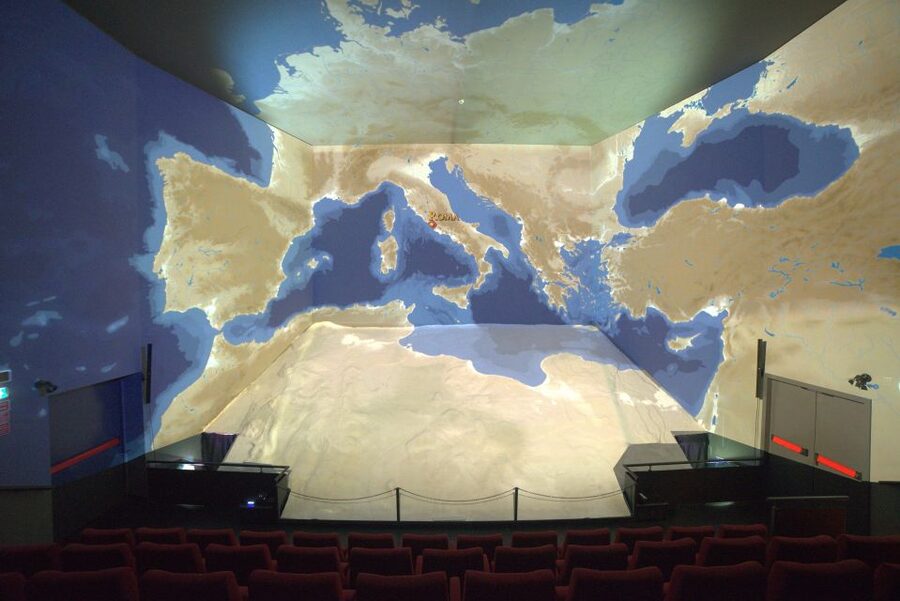
The central presentation uses projections on walls and ceilings, with a large model of Rome on the floor. The model lights up as the city changes, while the projections carry you over streets, buildings, squares, and monuments.
The effect is less like a traditional museum film and more like a short visual performance. You are shown Rome from above, then brought closer to important buildings and public spaces. The changing view helps explain how the city’s parts relate to one another.
The program covers 2,700 years in 27 minutes. That is both its strength and its limit. You get a clear outline of the major periods, but not a detailed lesson on every emperor, architect, battle, or church. The pace is brisk because it has a huge amount of ground to cover.
For most people, that is the right choice. A first-time visitor often needs the broad shape of the story before collecting smaller facts. You can return to the Colosseum or Roman Forum with a better sense of where those places fit in the wider city.
The chronology also helps with Rome’s visual confusion. A ruined arch, a church facade, and a modern street can seem unrelated when you encounter them separately. In the show, you see how one age followed another and how old structures were reused, covered, or built around.
The presentation is available with an audio guide in nine languages: Italian, English, Spanish, French, German, Russian, Chinese, Croatian, and Japanese. That makes the experience useful for families and groups who do not want to rely on English explanations.
The city model makes the big picture clearer
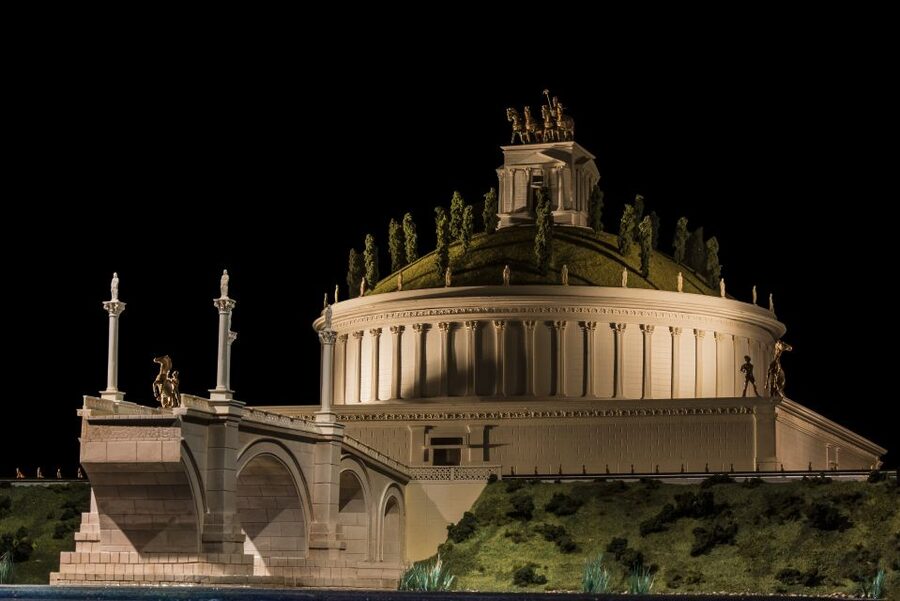
The large ground model is one of the most useful parts of the experience. Rome is not easy to picture from individual viewpoints, especially when you are standing among ruins and cannot see the original street plan.
As the model lights up, you can follow the city’s growth and understand the relationship between major areas. The scale helps connect places you may visit on separate days. It also gives you a better sense of how ancient Rome occupied the same ground as modern Rome.
I like this approach because it deals with a common problem in Roman sightseeing: fragments can be impressive but confusing. A model gives you the missing whole. You can then look at the real ruins with a more informed eye.
The show’s visuals are designed to be easy to follow rather than academic. That suits a short introduction. If you already know Roman history in detail, you may find the narration basic, but the moving images and city views can still provide a useful refresher.
Same place, a different night out:
- Rome: Caracalla Baths & Circus Maximus — Private or Shared
★ 4.7 · 835 reviews - Rome: Gladiator Show and Museum Tickets
★ 4.5 · 237 reviews - Milan: Maison Milano Dinner and Show
★ 4.1 · 140 reviews - Rome: Small-Group Tour of Caracalla Baths and Circus Maximus
★ 5.0 · 140 reviews
Four interactive models worth taking your time with
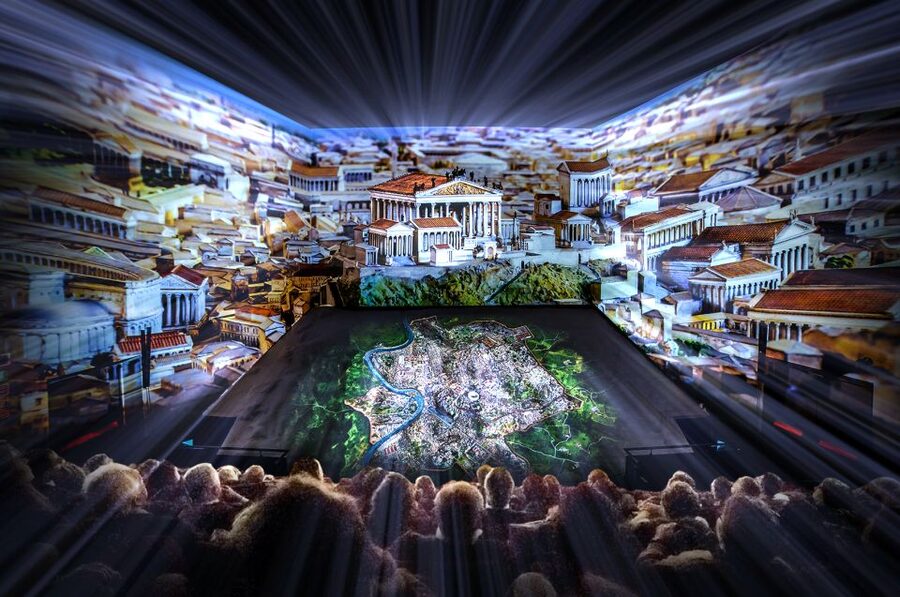
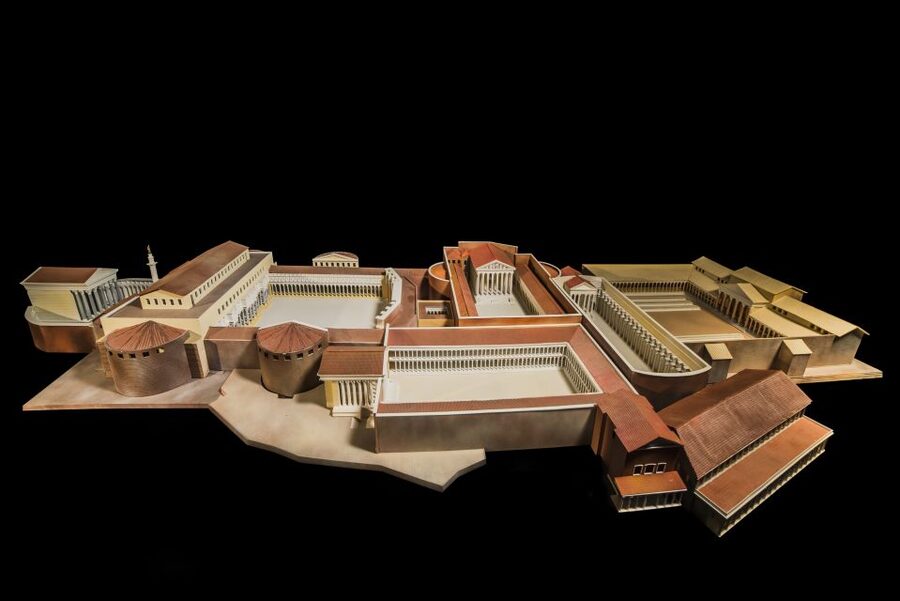
After the projection, you can examine four large interactive models. They focus on the Imperial Forum, Augustus Forum, Mausoleum of Hadrian, and St. Peter’s Basilica.
The Imperial Forum model helps you picture the series of civic and political spaces that once formed the heart of ancient Rome. Today, these ruins are spread across a busy archaeological area, and it can be difficult to see how the pieces fit together. A model gives you a cleaner view of the original arrangement.
The Augustus Forum model focuses on one of Rome’s most important imperial projects. Looking at it as a complete space helps you understand the ambition behind the surviving fragments. The real site is much more powerful once you can picture the buildings, walls, and public setting that have been lost.
The Mausoleum of Hadrian model is particularly useful because the monument changed purpose over time and is now known as Castel Sant’Angelo. Seeing its earlier form helps connect the imperial structure with the later fortress and landmark beside the Tiber.
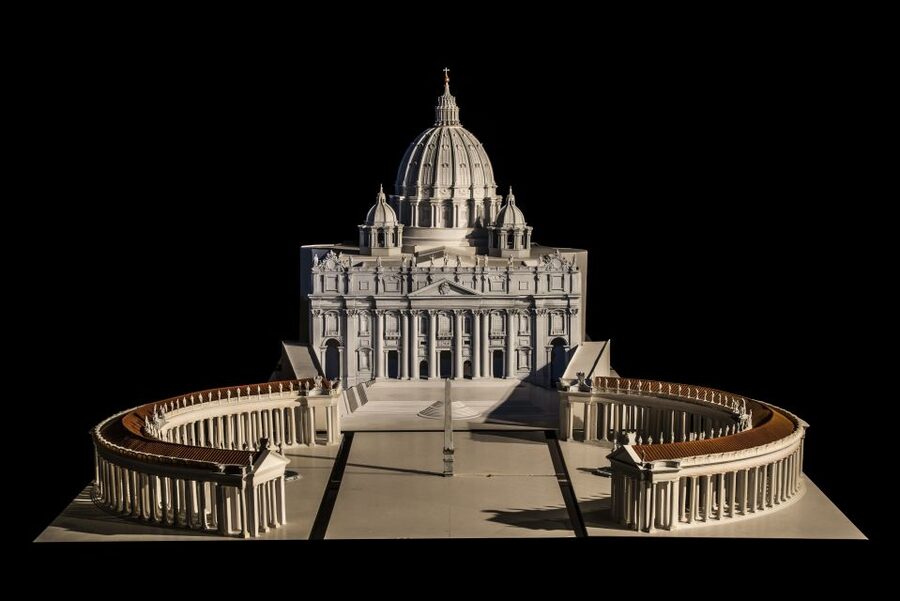
The St. Peter’s Basilica model shifts the focus to a major Christian monument. It gives you a way to study the building as a whole, something that can be difficult when you are standing inside a vast basilica or viewing it from a crowded square.
You do not need to rush through these models. The film is fixed at 27 minutes, but the models let you spend more or less time on the subjects that interest you. Some areas may require standing, so visitors who need regular seating should plan accordingly. The projection and interactive exhibits are wheelchair accessible.
The best time to visit
I would place this near the beginning of a Rome trip. Several parts of the experience work as preparation for the city’s major sights, especially the forums and ancient monuments.
Seeing the show first gives you a mental timeline. Later, when you walk through a ruin or enter a church, you have a better idea of what period you are seeing and what came before it. That can turn a string of impressive but disconnected stops into a more readable story.
There is also a good argument for visiting after sightseeing. If you have already walked through the Colosseum, forums, churches, and historic center, the projections can help organize what you saw. Familiar buildings and neighborhoods become easier to place in time.
For most first-time visitors, though, before is more useful than after. If your schedule allows, go on your first or second day. An early visit may also be quieter, though crowd levels can change.
The show is also a sensible option on a hot afternoon or during a short break from outdoor sightseeing. It provides an indoor activity without demanding half a day. Just remember that the experience is compact, not a full-day attraction despite the ticket being valid for one day.
Is $21 a fair price?
At $21, Welcome To Rome sits above the price of a simple museum admission but below the cost of a major guided tour. The value depends on what you want from it.
If you are looking for a detailed history course, the price may feel high for a 27-minute central film. The content is intentionally broad, and you will still need to visit the actual monuments to see Rome properly.
If you want a clear introduction, the calculation improves. You receive the projection show, the city model, four interactive monument models, and an audio guide in your chosen language. The flexible arrival time also makes it easier to fit into a busy day.
Families may find the visual format more useful than a long historical talk. Children can follow the changing buildings and city model even when dates and names begin to blur. Very young children may not stay engaged throughout, so the age and attention span of your group matter.
I would call it reasonable value for a first visit, especially if you plan to see several ancient sites afterward. It is less compelling if you already know Rome’s history well or have only a short time and must choose between this and a major monument.
Who will enjoy this most
This is a strong choice for first-time visitors who want context before exploring. It also suits people with limited time, since you can get a broad introduction without giving up a full morning or afternoon.
Families with school-age children may appreciate the mix of sound, light, models, and motion. The format is easier to follow than a long block of text, and the chronological structure gives children a basic framework for the city.
History fans will enjoy seeing the ancient monuments reconstructed and placed within the modern city. The presentation is not a specialist lecture, but it provides a useful visual review even if you already know the main story.
It can also help repeat visitors. Rome reveals more with each trip, and a quick overview may connect places that were previously visited as separate stops.
I would be more cautious if your schedule is extremely tight, if you dislike screen-based attractions, or if you expect a full guided tour with a live historian. This is an audio and projection experience, not a walk through Rome and not a substitute for standing in front of the real buildings.
Practical details for planning your visit
The entrance is at Corso Vittorio Emanuele II, 203, a few hundred meters from Piazza Navona. Put the address into your route plan carefully, since the historic center has many similar-looking streets and major landmarks.
The show runs continuously during opening hours, so you do not have to arrive at one exact departure time. The ticket is valid for one day, and the final show starts one hour before closing.
The activity is wheelchair accessible, including the projection and interactive exhibits. If someone in your party cannot stand for long periods, check the seating arrangement on arrival, since the models may involve more standing than the main presentation.
The audio guide covers nine languages: Spanish, Chinese, English, French, German, Italian, Japanese, Russian, and Croatian. Free cancellation is available up to 24 hours in advance, and you can reserve now and pay later if that option appears for your chosen booking.
Should you book Welcome To Rome?
Book it if you want a short, visual introduction that will make Rome’s monuments easier to understand. I especially recommend it on the first or second day of a trip, before visiting the Colosseum, Roman Forum, and other major sites.
Skip it if you have already studied Roman history in depth, dislike multimedia presentations, or need to choose between this and a once-in-a-lifetime monument visit. At $21, it is not an essential replacement for Rome itself.
For most first-time visitors, though, the combination of a clear timeline, glowing city model, and four monument models makes this a useful orientation stop. Give it about an hour in your plans, then use what you learned outside, where Rome’s real layers are waiting around every corner.
FAQ
Where is Welcome To Rome located?
The entrance is at Corso Vittorio Emanuele II, 203, in Rome. It is a few hundred meters from Piazza Navona.
How long is the main show?
The main projection presentation lasts 27 minutes. Allow extra time to view the four interactive models before or after the show.
Can I arrive at any time?
Yes. The show runs continuously during opening hours, so you can begin your visit when you arrive.
When does the last show begin?
The last show starts one hour before closing time.
What languages are available?
The audio guide is available in Italian, English, Spanish, French, German, Russian, Chinese, Croatian, and Japanese.
What does the ticket include?
The ticket includes entrance to the Welcome To Rome multimedia show.
Which monuments are shown in the interactive models?
The models cover the Imperial Forum, Augustus Forum, Mausoleum of Hadrian, and St. Peter’s Basilica.
Is the experience wheelchair accessible?
Yes. The projection and interactive exhibits are accessible to wheelchair users.
Is this a good activity before visiting Rome’s main sights?
Yes. The show gives you a chronological overview that can help you understand the Colosseum, forums, churches, and other monuments during later visits.
Can I cancel my booking?
You can cancel up to 24 hours in advance for a full refund, according to the booking terms.
Just added around Italy
- Mozzarella Live Show & Tasting in a Cheese Factory★ 5.0 · 2 reviews
- Syracuse: Sicilian Puppet Show with visit behind the scenes★ 4.8 · 49 reviews
- Syracuse: Museum Guided Tour with Sicilian Puppet show★ 4.1 · 27 reviews
- Rome: Private Caracalla Baths & Circus Maximus Tour for Kids★ 5.0 · 2 reviews
- Rome: Rooftop Bar Opera Show★ 4.6 · 94 reviews
- Rome: E-bike Tour From The Circus Maximus To The Catacombs★ 5.0 · 3 reviews
- Rome: Musical Biography of Frank Sinatra Concert★ 3.9 · 100 reviews
- Rome: Gladiator Show and Museum Tickets★ 4.5 · 237 reviews
Italy Shows, compared.
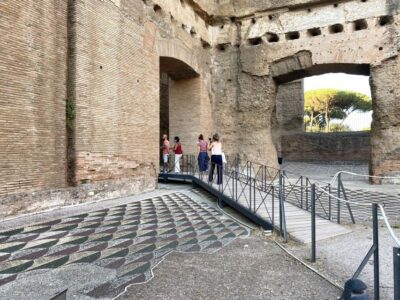
Caracalla Baths & Circus Maximus — Private or Shared
Read our review →
Glass Blowing Show Visit Murano Glass Factory & Showroom OMG
Read our review →

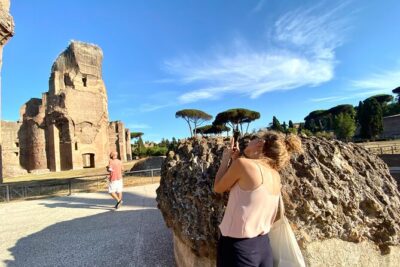
Small-Group Tour of Caracalla Baths and Circus Maximus
Read our review →
Browse the lists this show appears in