
Review · KYOTO
One Hour Geisha Show in Kyoto
Seeing a real maiko, or apprentice geisha, perform at close range is the heart of this Kyoto experience. Her dances are short by design, usually about five to ten minutes each, so this is not a full hour of nonstop entertainment. It is a cultural meeting with dance, questions, photos, tea, and a traditional game woven into the hour.
I like the chance to ask direct questions, especially with guides such as Genki, Rin, Ai, and Taira Yoshino translating and explaining the details. I also like the small touches: matcha or water, Japanese snacks, a photo with the maiko, and, with the tea house option, a walk to Kitano Tenmangu Shrine. The main drawback is that the two tour formats are quite different, and mixed-language groups can make the explanations harder to follow.
Key points at a glance
- Two short dances protect the traditional format: Expect graceful performances of about five minutes each rather than an hour-long stage show.
- The tea house and theater options are different: The tea house uses a Kyoto-style Kyo-Machi-ya and includes a shrine visit, while the Gion Theater option takes place in a showhouse.
- Your questions are part of the experience: Guides translate and explain the maiko’s clothing, makeup, hair, accessories, work, and daily life.
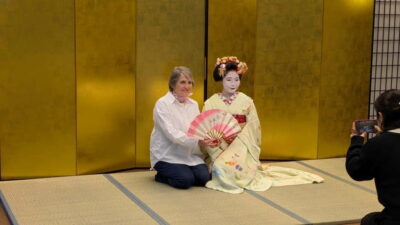
- Photos and videos are welcome: You can take pictures, record the dances, and have a photo opportunity with the maiko.
- The traditional game is a highlight: You may play Konpira Fune Fune, a quick Japanese game that is harder than it looks.
- Small groups keep it personal: The tea house accepts up to 23 people, while the theater option allows up to 30.
Why the maiko meeting matters in Kyoto
Kyoto is the place most closely associated with Japan’s geisha tradition, and a maiko is the apprentice in that world. She is not simply a costumed performer hired for a photo opportunity. Her hairstyle, makeup, kimono, and ornaments carry meaning, and the guides take time to explain those details before the dancing begins.
The experience is especially unusual because there are said to be only about 40 maikos left in Kyoto. That number gives the meeting some context. You are seeing a living art form that depends on years of practice, strict customs, and a small professional community.
I appreciate that the format does not try to turn the maiko into a nonstop stage attraction. The dances are intentionally brief. That may surprise you if you arrive expecting a one-hour concert, but the short performances fit the traditional style better and leave room for conversation.
This is also a respectful way to learn about geisha culture without relying on movie stereotypes. The question period lets you ask about her life and work, while the guide helps explain what can be difficult to understand across languages.
A few more shows around Japan worth a look
- 1 Hour Geisha Show in Kyoto
★ 5.0 · 452 reviews - Madrid: 1-Hour Traditional Flamenco Show at Centro Cultural
★ 4.8 · 1,593 reviews - Dinner show in agafay Desert 1h quad bike & 20 min camels
★ 4.9 · 407 reviews
Choosing between the Kyo-Machi-ya and Gion Theater
Read the option names carefully before booking. They are not two meeting points for the same show.
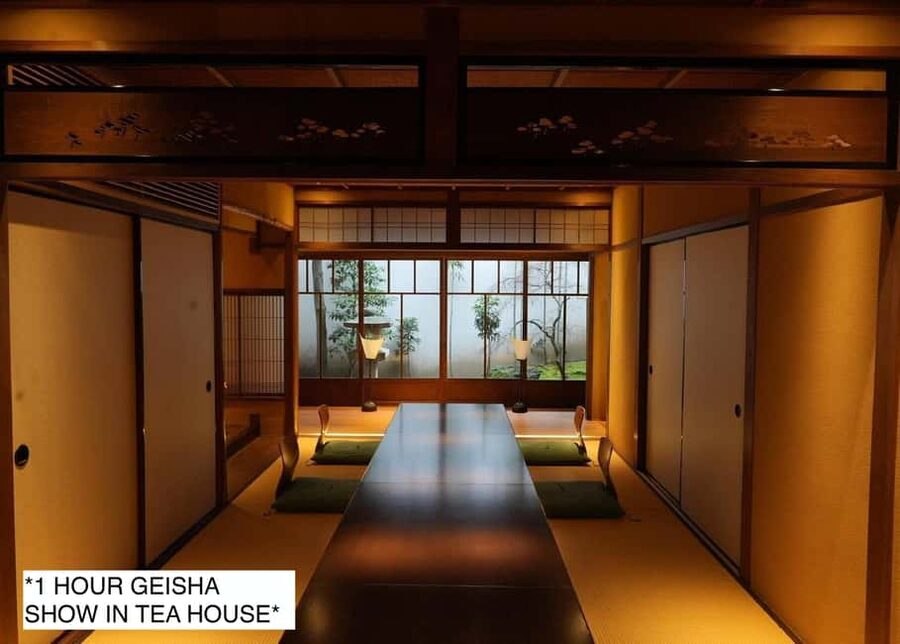
The Tea House option takes place in a Japanese Kyo-Machi-ya, a traditional Kyoto-style house. It includes tea and Japanese snacks, plus a 30-minute session at Kitano Tenmangu Shrine with the maiko. The itinerary may begin at one of the listed meeting points and then continue to the tea house before moving to the shrine.
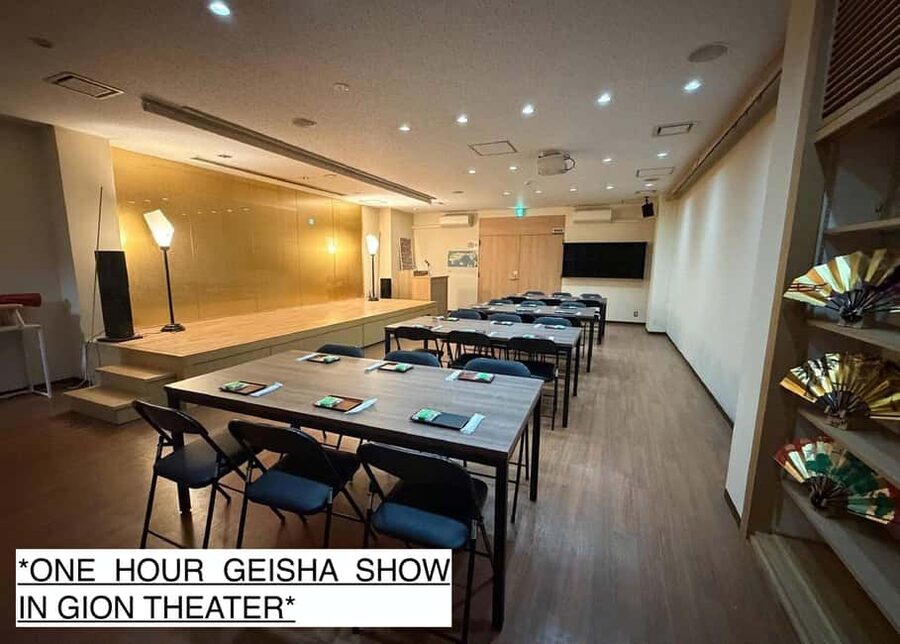
The Gion Theater option takes place in a showhouse. It is wheelchair accessible, unlike the tea house option, and it allows up to 30 people. It does not include the shrine walk listed for the tea house program.
I would choose the tea house option if the setting matters to you and you want the added shrine visit. The theater option makes more sense if wheelchair access is important or if you prefer a straightforward indoor performance space. Do not assume that booking one gives you the features of the other.
The meeting point can vary by option. Listed locations include Umeno, at 302-2 Daikokucho near KOHYO Kamishichikenten, and Kitano Tenmangu Shrine. Check your confirmation carefully so you do not wait at the wrong place.
What happens during the one-hour show
The show begins with an introduction to the maiko. You may learn about her clothing, hair, makeup, and accessories before the performance starts. This explanation adds useful context because the visual details can otherwise blur together if you are seeing a maiko for the first time.
The dancing follows. The usual structure is two dances, each lasting about five minutes, or one opening dance of roughly ten minutes depending on the presentation. The maiko may perform from more than one side of the room so that people seated in different positions can see her movements clearly.
The dances are controlled and precise rather than fast. The appeal is in the posture, hand movements, fan work, costume, and quiet concentration. You will not get an hour of continuous action, and that is worth repeating before you book. The remaining time is used for conversation and participation.
After the dance, the guide translates questions from the audience. Guides including Genki, Rin, Ai, and Taira Yoshino have been praised for making the exchange easier to follow. A good translator matters here because the most interesting part may be the small explanation behind a movement, ornament, or custom.
There is also a traditional Japanese game, often identified as Konpira Fune Fune. It is played with the maiko and looks simple until you try to keep up. It gives the session a lighter moment and lets you interact without treating the dance itself as a stage stunt.
You can take pictures and videos during the experience. A photo opportunity with the maiko comes at the end, and some sessions include a small name sticker as a good-luck keepsake. Those details vary by presentation, so enjoy them without treating them as guaranteed extras.
Tea, snacks, and the shrine visit
Tea and traditional Japanese snacks are included. You may be offered hot matcha or water, depending on your choice. This is a modest refreshment rather than a meal, so plan separate food if you need lunch or dinner.
The tea house setting gives the visit a more intimate feel. Sitting in a Kyoto-style house helps connect the performance to the city’s traditional architecture instead of placing it only on a modern stage. You should expect Japanese customs, including the requirement to wear socks and the prohibition on bare feet.
The tea house program also includes about 30 minutes at Kitano Tenmangu Shrine with the maiko. The shrine visit gives you time to see her outside the performance room and adds a walking element to the experience. It is not part of the Gion Theater option, so this is one of the biggest reasons to compare the two bookings before paying.
The listed drop-off points include Umeno, Kitano Tenmangu Shrine, and 302-2 Daikokucho. That can make the tea house program easier to fit with sightseeing in the Kitano area. You still need to allow for the stated total duration, which can range from one hour to about 105 minutes depending on the option and schedule.
Same place, a different night out:
- Mt Fuji & Hakone Cruise, Drum Show Bullet Train 1 Day from Tokyo
★ 4.0 · 7,413 reviews - Tokyo: Sumo Show Experience with Chicken Hot Pot and a Photo
★ 4.8 · 6,678 reviews - Tokyo: Sumo Show and Dining Experience
★ 4.8 · 2,742 reviews - Tokyo: Japanese Dance Cabaret Theater Asakusa-Kaguwa Ticket
★ 4.8 · 2,270 reviews
Guides, languages, and group size
The tour is offered in English and Korean. The guides do more than point out the next activity. They explain the maiko’s appearance, translate questions, and help the audience understand the social rules around the performance.
Named guides connected with the sessions include Genki, Chihiro, Rin, Ai, and Taira Yoshino. Genki is especially useful as an interpreter in several accounts, while Ai and Rin are noted for clear, friendly hosting. The exact guide depends on the date and option, so do not book expecting a particular person unless the provider confirms it.
Group size is limited to 23 people at the tea house and 30 at the Gion Theater. Those are not private-tour numbers, but they are small enough for a shared question period and a photo opportunity. If every person asks several questions, the available time can feel tight.
One practical caution: a mixed-language audience can slow the explanations. English, Korean, Chinese, and other languages may be represented in the same room, and translation takes time. If you want a very quiet, private lesson, this is not that. If you are comfortable with a group format, the shared questions can broaden what you learn.
The value at about $50 per person
At roughly $50 per person, this is not the cheapest cultural activity in Kyoto. You are paying for a rare meeting, a live traditional dance, a guide, translation, tea, snacks, and, with the tea house choice, a shrine session.
The value depends on what you want from a show. If you only want a long dance performance, the short format may feel expensive. If you want a direct introduction to maiko culture with the chance to ask questions and take photos, the price is easier to justify.
I see the strongest value in the combination of access and explanation. A dance viewed from a distance gives you beauty but little context. Here, you can learn what you are looking at, meet the performer, join a game, and leave with photographs.
The tea house option gives you more for the same general type of outing because it adds Kitano Tenmangu Shrine. The theater option may still be the better buy for anyone who needs wheelchair access or wants the simplest indoor setup.
Practical advice before you go
Wear socks. This is required, and bare feet are not allowed. The rule matters most for the tea house option, where traditional indoor customs apply.
Bring a phone or camera with enough battery and storage for photographs and video. Recording is allowed, and the dance is short, so you may want to be ready before the maiko begins rather than sorting through settings afterward.
Give the provider a phone number that works during your time in Japan and on WhatsApp. The number should belong to the person attending, not a travel agency. This allows the organizers to send instructions and handle last-minute communication.
Strollers are not allowed, and alcohol and drugs are prohibited. The tea house option is not wheelchair accessible, while the Gion Theater option is listed as wheelchair accessible. The experience is also not suitable for people over 95.
The activity is designed for a range of ages, but young children may find the quiet dance and question period less exciting than the game or photo session. Since strollers are not allowed, families should plan accordingly.
Cancellation is free up to 24 hours before the start time, and you can reserve now and pay later. That flexibility helps if your Kyoto schedule depends on weather, train plans, or another timed attraction.
Who will enjoy this most
I would recommend it to anyone curious about traditional Japanese performance, especially if you prefer a personal introduction over a large stage show. Photographers will appreciate the chance to take pictures and video, while culture-minded visitors will value the explanations about costume and work.
It suits a first visit to Kyoto because it gives you an accessible entry point into a tradition that can otherwise seem closed to outsiders. The guide removes much of the language barrier, and the question period lets you focus on what you genuinely want to know.
It is also a good fit after sightseeing in Gion or the Kitano area. One person used it as a follow-up to the Gion Kagai Art Museum, and that pairing makes sense: a museum gives you background, while the maiko show lets you see a living performance.
I would be more cautious if your main goal is a long dance recital, a private meeting, or a meal. This is not a dinner experience, and the maiko does not perform continuously for an hour. It is a short dance presentation followed by learning, conversation, play, and photos.
Should you book the maiko show?
Book it if you want a rare, respectful introduction to Kyoto’s maiko tradition and you are happy with a compact performance rather than a full theatrical program. The strongest version is the tea house option, since it combines the Kyo-Machi-ya setting, tea, snacks, two dances, questions, photos, the game, and Kitano Tenmangu Shrine.
Choose the Gion Theater option if wheelchair access is needed or if a showhouse suits your plans better. Before confirming, check the exact meeting point, option name, language, and duration.
For about $50, I think the experience offers good value when you care about contact and context. The photographs are a bonus. The real reason to go is the chance to watch a maiko up close, ask thoughtful questions, and see a Kyoto art form presented with the calm, brief grace that gives it meaning.
FAQ
How long does the experience last?
The activity lasts from one hour to about 105 minutes, depending on the option and schedule.
Does the maiko perform continuously for one hour?
No. The performance usually consists of two short dances of about five minutes each, or an opening dance of roughly ten minutes. The rest of the time includes explanations, questions, a game, and photos.
Is the performer a real maiko?
Yes. The experience features a real maiko, an apprentice geisha.
Can I take photographs and videos?
Yes. Photography and video recording are allowed during the experience.
Is there a photo opportunity with the maiko?
Yes. There is time to take a photo with the maiko after the performance and activities.
What are the two tour options?
The Tea House option takes place in a Kyoto-style Kyo-Machi-ya and includes a shrine session. The Gion Theater option takes place in a showhouse and is wheelchair accessible.
Does every option include Kitano Tenmangu Shrine?
No. The 30-minute Kitano Tenmangu Shrine session with the maiko is only included with the Tea House option.
What languages are available?
Live guidance is available in English and Korean.
Is tea included?
Yes. Tea and traditional Japanese snacks are included. Additional drinks and food are not included.
Do I need to wear socks?
Yes. You must wear socks, and bare feet are not allowed.
How many people can join?
The Tea House option allows up to 23 people. The Gion Theater option allows up to 30 people.
Is the activity wheelchair accessible?
The Gion Theater option is wheelchair accessible. The Tea House option is not.
Can I cancel for a full refund?
Yes. You can cancel up to 24 hours in advance for a full refund.
Can I reserve without paying immediately?
Yes. The reserve-now, pay-later option lets you hold your place without paying at the time of booking.
Just added around Japan
- Authentic Kabuki Transformation & Mini Performance at Aioiza Gifu★ 4.5 · 3 reviews
- Kabuki Talk★ 5.0 · 10 reviews
- Tokyo: English Standup Comedy Night★ 5.0 · 4 reviews
- Experience the Asakusa Kabuki Opera Show!★ 5.0 · 99 reviews
- Tokyo: Taishu Engeki Show with Kimono and Sword Lesson★ 5.0 · 12 reviews
- Tokyo: Traditional Geisha Experience Show & Japanese Dinner★ 4.2 · 59 reviews
- Tokyo: Rainbow Bridge Day Cruise Show Unlimited Soft Drinks★ 4.5 · 86 reviews
- Tokyo: Taiko Drum Experience in Kabukicho with Dinner★ 5.0 · 3 reviews
Kyoto Shows, compared.
Kyoto Gion Cultural Walk & Geisha Show with Dining Options
Read our review →Kyoto Gion Cultural Walk & Geisha Show with Dining Options
Read our review →
Gion Walking Tour, Geisha Show and Japanese Game in Kyoto
Read our review →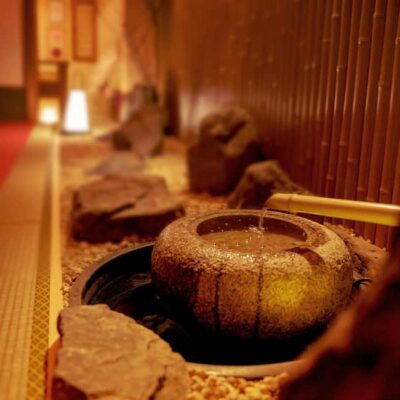
Browse the lists this show appears in